
Halal Food Market Revenue to Double by 2032, Reaching USD 6751.81 Billion: New Analysis by Maximize Market Research
Halal Food Market graph
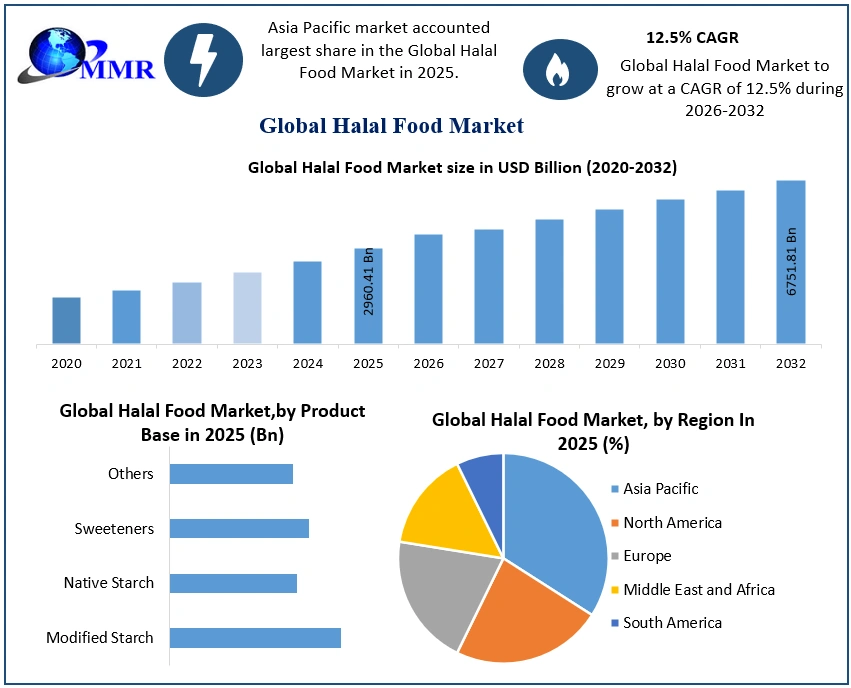
The Halal Food Market was valued at USD 2,960.41 billion in 2025 and is projected to reach USD 6,751.81 billion by 2032, growing at a CAGR of 12.5%.
Beyond religion, Maximize Market Research identifies a $6.7 Trillion ethical shift where halal certification becomes the ultimate global safety benchmark.”
ROCKVILLE , MD, UNITED STATES, March 24, 2026 /EINPresswire.com/ -- The global Halal Food Market is undergoing a seismic shift in consumer behavior and market valuation, according to the latest strategic disclosure by Maximize Market Research. Valued at an impressive USD 2960.41 Billion in 2025, the industry is projected to accelerate at a CAGR of 12.5%, reaching a milestone revenue of USD 6751.81 Billion by 2032. This exponential growth is underpinned by the dual drivers of a rapidly expanding global Muslim population—expected to reach 2.2 billion by 2030—and a surging demand for "Tayyib" (wholesome) products among health-conscious non-Muslim consumers. As the market transitions into a mainstream global powerhouse, Maximize Market Research identifies a critical convergence between traditional Shariah-compliance and modern ESG (Environmental, Social, and Governance) standards. This evolution is redefining supply chain transparency, positioning halal certification not merely as a religious requirement, but as a premium benchmark for food safety, hygiene, and ethical integrity in the 2026-2032 forecast period.— Maximize Market Research
Get Full PDF Sample Copy of Report: (Including Full TOC, List of Tables & Figures, Chart) @ https://www.maximizemarketresearch.com/request-sample/28343/
Halal Food Market Dynamics: Strategic Drivers Behind the USD 6751.81 Billion Valuation
The trajectory toward a USD 6751.81 Billion valuation by 2032 is fueled by a shift where "Halal" acts as a proxy for "Clean Label" integrity. Beyond demographic growth, multinational giants like Nestlé have established Malaysia as a Global Halal Centre of Excellence, exporting 500+ certified products to over 50 countries. Similarly, French retailer Carrefour has expanded specialized halal aisles to capture burgeoning multiethnic demand, signaling a move into mainstream global retail.
Furthermore, the "Tayyib" (wholesome) concept attracts ethical shoppers prioritizing antibiotic-free products. In the United Kingdom, where the Muslim population exceeds 4 million, demand for organic halal poultry is surging, allowing brands to command premium pricing through ESG alignment. While the lack of a unified global standard remains a challenge, the shift toward digital harmonization is lowering international entry barriers, sustaining the industry’s robust expansion through the 2032 forecast period.
The Ethical-Halal Food Market Convergence: Vegan, Organic, and Clean-Label Synergy
A defining shift in the industry is the rapid convergence of religious standards with the global "Green" movement. Modern consumers are increasingly seeking a "Halal-Vegan" crossover, where plant-based ethics and Shariah-compliance align. This synergy is particularly potent in Western Europe, where the number of halal-certified food products has grown by over 30% in the last five years. Research indicates that young Gen Z and Millennial demographics are prioritizing sustainability, with nearly 74% of consumers now open to plant-based alternatives that meet strict hygiene and ethical benchmarks.
A Real-World Example of this trend is seen in the United Kingdom, where specialized startups are capturing the "Conscious Consumer" segment by offering 100% plant-based meat alternatives. Furthermore, global FMCG leaders are integrating Halal-Organic certifications to appeal to non-Muslim health enthusiasts, who now represent a significant portion of the market's expansion. This ethical alignment ensures that products meet the "Tayyib" (pure) standard, satisfying the demand for antibiotic-free and eco-friendly nutrition.
Halal Food Market Tech & Traceability: AI and Blockchain-Driven Transparency
The digital transformation of the Halal Food Market is solving the historical challenge of fragmented certification. Blockchain technology is now being deployed to create immutable "Farm-to-Fork" ledgers, allowing consumers to verify Shariah-compliance via a simple QR code scan. This shift is critical as global trade expands; for instance, Malaysia’s Halal Integrated Platform (HIP) successfully connects thousands of SMEs to a digital ecosystem, streamlining the verification process across borders.
Beyond tracking, Artificial Intelligence (AI) is revolutionizing ingredient analysis. Laboratory-grade AI sensors can now detect non-halal DNA or alcohol traces with 99.9% accuracy in seconds, a process that previously took days. Leading the charge is the Saudi Arabian "Smart Halal" initiative, which utilizes IoT-enabled cold chains to ensure products remain "Tayyib" (pure) during transit. These innovations are reducing certification costs by approximately 20%, making it easier for international exporters to enter high-growth markets without compromising on strict religious or hygiene standards.
Halal Food Market Regional Deep-Dive: APAC and European Growth Hubs
The Asia-Pacific (APAC) region remains the dominant force, currently commanding over 55% of the global market share. This leadership is driven by the vast Muslim populations in Indonesia, Pakistan, and Bangladesh, alongside a rapidly maturing middle class with rising disposable incomes. Market observations highlight that Indonesia’s 2024-2026 mandatory Halal certification laws are acting as a catalyst for local manufacturing, encouraging international brands to localize their supply chains to maintain market access.
Simultaneously, Europe is emerging as a high-value growth hub, with a projected annual growth rate of 8.5% for premium Halal goods. In countries like France and Germany, the demand is no longer confined to traditional butcher shops but has moved into mainstream hypermarkets. Case in point: the expansion of specialized Halal aisles in Tesco and Sainsbury’s across the UK, which caters to a demographic that spends significantly more per capita on high-quality meat and "Tayyib-certified" organic products than the global average.
High-Growth Niche Segments in the Halal Food Market
Beyond traditional proteins, the Halal Food Market is diversifying into high-margin "Blue Ocean" territories. A primary growth engine is the Halal-certified Functional Foods segment, which includes probiotics, protein isolates, and collagen-based beauty supplements. As health-conscious consumers seek "Tayyib-compliant" wellness products, the demand for Halal-certified whey protein and infant formula is surging in the Middle East and Southeast Asia.
Industry evidence is seen in the pharmaceutical crossover, where the shift toward bovine-free and porcine-free gelatin capsules is becoming a global manufacturing standard. Furthermore, the Halal-Dairy alternative market is expanding as brands integrate plant-based milks with Shariah-compliant emulsifiers to capture the "Ethical-Halal" demographic. Market observations highlight that these specialized segments are growing at nearly 1.5x the rate of the broader industry, offering a strategic entry point for brands looking to avoid the price wars of the commoditized meat sector.
Get Full PDF Sample Copy of Report: (Including Full TOC, List of Tables & Figures, Chart) @ https://www.maximizemarketresearch.com/request-sample/28343/
By Product
Meat, Poultry, and Seafood
Fruits and Vegetables
Dairy Products
Cereals and Grains
Confectionery
Oil, Fats, and Waxes
Others
By Certification Type
Halal Certified
Halal Compliant
Non-Certified
By Packaging Type
Flexible Packaging
Rigid Packaging
Canned Packaging
Frozen Packaging
Analyst Perspective
The evolution of the Halal Food Market represents a move from religious compliance to a global benchmark for quality and food safety. We are observing a significant 'Premiumization' trend where the consumer base is no longer defined solely by faith but by a preference for ethical, 'Tayyib' standards. This shift is particularly evident in the rapid adoption of digital traceability and clean-label certifications. To remain competitive, manufacturers must pivot from commoditized products to value-added segments like functional nutrition and sustainable dairy alternatives, which are currently experiencing a higher-than-average growth trajectory across non-OIC markets.
Halal Food Market Competitive View: Strategic Consolidation and Global Expansion
The competitive landscape of the global Halal Food Market is evolving through aggressive diversification by multinational leaders. Industry giants like Unilever, Cargill, and BRF S.A. are expanding their production capacities to capture the "Mainstream Halal" shift in Western retail. A notable industry milestone is the recent acquisition of Pure Ingredients by GoodLife Foods, aimed at dominating the European halal frozen snack segment. Simultaneously, Nestlé maintains its leadership by leveraging a specialized supply chain that accounts for nearly 35% of its global sales, reflecting a broader trend where established conglomerates acquire niche brands to secure localized certification trust.
Halal Food Market, Key Players
Nestle S.A. Nestlé S.A. (Switzerland)
Cargill, Incorporated (U.S.)
Al Islami Food (Dubai)
BRF S.A.
Udine
Yildiz Holding
Kellogg’s Company
WH Groups Ltd.
Neema Food Company
Tahira Halal
Midamar Corporation
Saffron Road Industries
Sierra Meat Industries
Tahira Food
Chicken Cottage
Get access to the full description of the report @ https://www.maximizemarketresearch.com/market-report/global-halal-food-market/28343/
FAQ’s
What is the "Tayyib" concept in halal food?
Ans: Beyond religious compliance, "Tayyib" emphasizes "wholesomeness," focusing on ethical sourcing, animal welfare, and the absence of GMOs or harmful additives.
Which region shows the fastest growth in halal production?
Ans: While APAC is the largest, Western Europe is the fastest-growing hub, with a 30% rise in certified manufacturers meeting ethical-consumer demand.
How is AI impacting halal certification?
Ans: AI-driven sensors now detect non-halal DNA with 99.9% accuracy, significantly reducing laboratory lead times and certification costs for international exporters.
Is the market expanding beyond Muslim consumers?
Ans: Yes. Approximately 25% of European halal consumers are non-Muslims who prioritize the hygiene and safety standards associated with halal-certified products.
Related Reports
Halal cosmetics market: https://www.maximizemarketresearch.com/market-report/global-halal-cosmetics-market/69023/
Meat Market: https://www.maximizemarketresearch.com/market-report/global-meat-market/121639/
Meat Substitute Market: https://www.maximizemarketresearch.com/market-report/global-meat-substitutes-market/27256/
Meat Processing Equipment Market: https://www.maximizemarketresearch.com/market-report/global-meat-processing-equipment-market/27045/
Meat Flavours Market: https://www.maximizemarketresearch.com/market-report/meat-flavours-market/194204/
Top Reports:
Root Beer Market
Instant Camera Market
About Maximize Market Research
Maximize Market Research is a global business intelligence firm empowering Fortune 500 companies across 45 countries. We provide high-impact, data-driven strategic intelligence to navigate industrial shifts and secure market dominance.
Domain Focus: Food & Beverages
Our research deciphers the global convergence of Shariah-compliance and ethical sustainability. We analyze "Tayyib" consumer psychographics, evaluating high-value shifts in clean-label innovation, digital traceability, and AI-driven certification across the evolving global halal ecosystem.
Lumawant Godage
MAXIMIZE MARKET RESEARCH PVT. LTD.
+ +91 96073 65656
email us here
Visit us on social media:
LinkedIn
Instagram
Facebook
X
Legal Disclaimer:
EIN Presswire provides this news content "as is" without warranty of any kind. We do not accept any responsibility or liability for the accuracy, content, images, videos, licenses, completeness, legality, or reliability of the information contained in this article. If you have any complaints or copyright issues related to this article, kindly contact the author above.
